
You know that hoodie in your drawer that you keep reaching past? The shoulders sit funny, or the chest pulls when you lean forward, or the sleeves stopped at some point above your wrist and apparently decided that was fine. Maybe you bought it two years ago and it fit okay at the time, but something shifted. Or maybe it never fit right and you just never got around to replacing it because, well, it's a hoodie. How bad can the wrong hoodie really be?
Bad enough that you grab it last every single time, and that's how bad.
Key Takeaways
- Check the shoulder seam first. It should sit right at the bony tip of your shoulder, not sliding down toward the bicep or riding up toward your neck. Everything else in a hoodie follows from this one checkpoint, and it takes two seconds in a mirror.
- For standalone wear, the hem should land 2 to 3 inches below your waistband. If you're planning to layer under a coat, size up one. That extra room through the chest is the difference between comfortable and fighting your jacket all day.
- Our hoodies are pre-shrunk at 8 to 10 oz cotton fleece. The fit you try on (or the fit in the size chart) is the fit you keep. Don't buy a size down expecting it to tighten up in the wash, because it won't.
Here's the short version. Shoulder seam at the shoulder joint, enough chest room to layer a tee underneath without the fabric pulling, hem 2 to 3 inches past the waistband, sleeves to the wrist bone. Four checkpoints. If all four work, the hoodie fits. That's genuinely it. If you want to understand what to look for when you're standing in front of a mirror (or squinting at a size chart online, which is harder and less fun), keep going. The hoodies collection has measurements listed by size on each product page if you'd rather skip straight to numbers.
Should a Hoodie Be Tight or Loose?
Neither. You want a relaxed fit with room to move, but not so much room that the fabric is just hanging there like a curtain you accidentally put on.
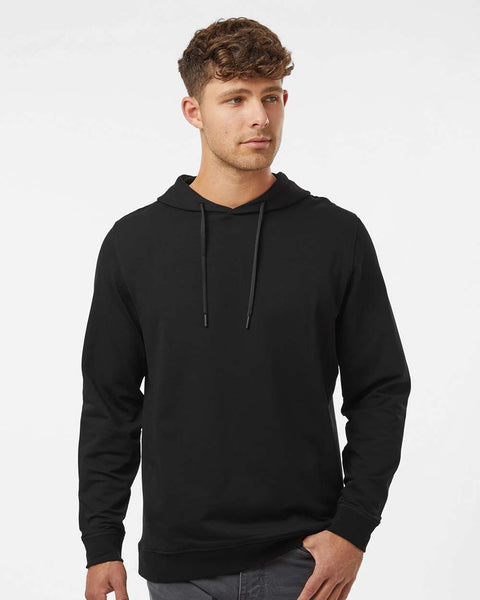
When the fit is right, the chest panel lies flat and you can reach forward or raise both arms without anything pulling or restricting. There's a difference between deliberately oversized (a style choice that can look good, especially with slim jeans or joggers underneath) and just wrong (diagonal tension lines running from the armhole across the chest). The tension lines mean too small, not oversized, and I see guys confuse these two constantly.
And here's a thing nobody talks about: if you can see the outline of whatever you're wearing underneath through the front panel, the hoodie is too tight for that base layer. A t-shirt shouldn't telegraph through 8 oz fleece, and if it does, the chest needs more room.
How Should a Hoodie Fit on the Shoulders?
This is the checkpoint that matters most, and it's the one most people skip entirely.
Find the seam where the shoulder meets the sleeve. It should sit right at the bony point of your shoulder, where the arm starts. Not halfway down your bicep, and not up near your neck. You can feel it through the fabric with two fingers in about a second.
If you're between sizes, the shoulder seam is usually what breaks the tie. The chest measurement might be close on both, but the shoulder seam will clearly be right on one and off on the other. We see this constantly with guys who have broader shoulders. They'll try a large, the chest is fine, but the shoulder seam has dropped an inch past the joint and the whole thing looks sloppy. Going down a size fixes the shoulders but makes the chest tight. You've traded one problem for another, and neither fit is actually right. (It's also why we cut ours with more room through the chest without widening the shoulders, because that trade-off shouldn't exist in the first place.)
One thing I didn't expect when I started paying attention to this: when the shoulder seam sits correctly, the hood also behaves. It doesn't pull forward or bunch at the back of your neck. A lot of hood fit complaints are actually shoulder fit problems wearing a disguise.
How Long Should a Hoodie Be?
The hem should hit about 2 to 3 inches below your waistband. At that length, it covers you fully when you move around and looks proportional on most torso lengths without getting into nightgown territory.
Above the waistband? Too short, and your back is going to say hello every time you reach for something on a shelf. Below mid-thigh? That's a deliberate long look, which works if you're going for it, but most guys aren't.
Quick test that takes two seconds: raise both arms overhead. If the hem stays below your waistband, you're good. If your stomach makes an appearance, the hoodie is too short for daily wear. I do this in every fitting room. Partly to test the hoodie and partly because I enjoy looking slightly ridiculous in public.
What About the Sleeves?
Sleeves should reach your wrist bone with a slight break. Most hoodies have ribbed cuffs that gather at the wrist, which helps keep them in place when you move. If the cuffs are sitting halfway up your forearm when your arms are at your sides, the sleeves are too short. Full stop.
Hold both arms forward at chest height. Cuffs at the wrist? Good. Riding up toward the elbow? Then the whole body of the hoodie is probably too small, not just the sleeves. Sleeve length is a symptom. And when sleeves are short, the torso is usually short too, and the shoulder seam has crept toward your neck. Everything is connected in a hoodie, and one wrong dimension usually means the whole size is off.
Does the Fit Change When You Layer?
Yes. And it's worth thinking about before you buy, not after you've already committed to a size that works perfectly in September and turns into a straitjacket in November with a coat over it.
Our hoodies run at 8 to 10 oz cotton fleece, which is midweight. Warm enough on its own in spring or fall, not so bulky that you can't throw a jacket over it. But what changes with layering is chest and shoulder room. But at true size, a structured coat over the top can make the chest feel tight and the shoulders restrictive, even if the hoodie fit fine on its own.
So for standalone wear, size true. For regular layering under a coat or jacket, go up one. That extra room won't make the hoodie look baggy on its own, but it'll save you from that compressed feeling where your coat is pushing the hoodie into your ribs and you can't really lift your arms above chest height without the whole thing binding. You know the feeling. We all know the feeling. Nobody talks about it because it seems too minor to complain about, but it ruins what should be a perfectly good coat-and-hoodie combination.
Should You Size Up or Down?
Size true. Our fleece is pre-shrunk, so what you buy is what you get after washing. Untreated cotton fleece can shrink 3 to 5% in a hot wash, which is exactly why pre-washing during production matters. So your medium stays a medium.
The exception: if you've got a broader chest and the true-size shoulder seam is slightly off, check the measurements on the product page before going up. Chest and shoulders are the two dimensions you can't fudge once the hoodie is sewn. But sleeves, you can push up. Hem, you can live with an inch either way. But the chest and shoulders? Those fit or they don't, and there isn't really a workaround once the seams are set.
We get asked about this more than almost anything else, actually. Guys want to know if they should size down and let the wash do the work. And the answer is no, because we already did it. Pre-shrunk means pre-shrunk. The medium you try on in September is the same medium you pull out of the dryer in March.
The hoodie styling guide goes deeper on building outfits around different fits if you've already got the sizing sorted and want to figure out what to actually wear it with.
Last updated: May 2026
FAQ
Should a hoodie be tight or loose?
A hoodie should have enough room to move without looking like you borrowed it from someone bigger. The chest panel sits flat, the shoulder seam lands at the shoulder joint, and raising both arms doesn't pull the hem above your waistband. Oversized on purpose is a style choice and it can look great. Tight because you bought the wrong size, with pulling across the chest and armhole seams, is a different problem entirely.
How long should a hoodie be?
The hem should fall about 2 to 3 inches below your waistband. That length keeps you covered when you bend, reach, or sit down without looking like a nightgown. Quick test: raise both arms overhead. If the hem stays below the waistband, the length works. If your stomach shows up, the hoodie is too short for everyday wear.
Should you size up or down in a hoodie?
Size true for standalone wear. Size up one if you regularly layer under coats, or if you have a broader chest and the shoulder seam sits better in the next size. Our fleece is pre-shrunk, so don't buy a size down expecting it to shrink into place. It won't. The medium stays a medium after 20 washes.
How should a hoodie fit on the shoulders?
The shoulder seam should sit right at the bony tip of your shoulder, where the arm begins. If the seam drops toward your bicep, the hoodie is too wide. If it rides up toward your neck, the back and chest are too narrow for your frame. This is the fastest way to tell if a hoodie fits, and it takes about two seconds in a mirror.
Can a hoodie stretch out over time?
Good fleece softens with wear but shouldn't stretch permanently if the cuffs are ribbed and the waistband is reinforced. The cuffs go first when a hoodie starts losing its shape, usually from being pushed up the forearms repeatedly. Washing cold and tumble drying on low keeps both the dimensions and the surface texture intact.


0 comments