
I own about fifteen t-shirts and wear maybe five of them. The other ten live in the drawer fulfilling some kind of fabric purgatory where they're not bad enough to throw out but not good enough to actually choose on purpose. And the thing that puts them there isn't colour or age or holes. It's fit. The shoulders sit a quarter inch too far out, or the chest pulls just enough to notice when I reach for my coffee, or the hem hangs at some length that makes every pair of jeans look slightly wrong for reasons I couldn't explain until I actually measured what was going on.
Key Takeaways
- The shoulder seam is the one fit point that has to be right before anything else matters. It sits at the bony edge of your shoulder joint, not drooping down your arm, not riding up toward your neck. If it's wrong, the whole shirt is wrong, and no amount of adjusting the other four checkpoints fixes a bad shoulder placement.
- A well-fitting t-shirt lets you pinch about one inch of fabric on each side at the waist. Less than half an inch and the shirt clings when you move. More than two inches and the shape collapses into a rectangle hanging off your body.
- Fabric changes how fit feels on your body. Bamboo viscose drapes where cotton holds structure, so the same measurements will feel looser in bamboo. That's the material, not a sizing mistake you need to fix by going down a size.
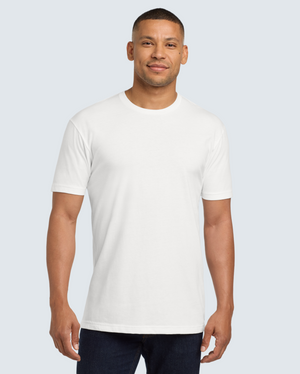
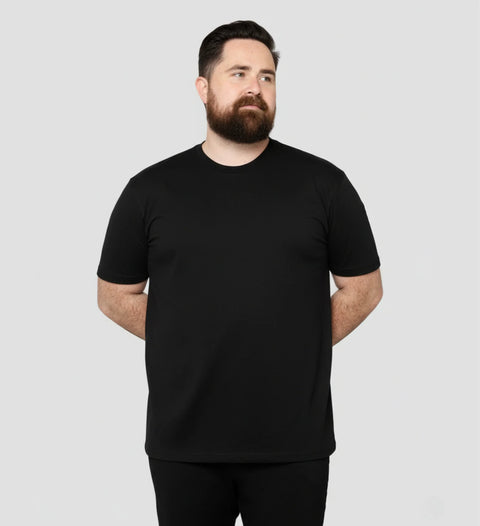
The quick answer: check five spots on any t-shirt and you'll know in thirty seconds whether it fits. Shoulder seam at the joint, chest flat with one to two inches of ease. Hem about two inches below the waistband, sleeves at mid-bicep. And roughly one inch of fabric you can pinch at each side of the waist. If all five line up, the shirt fits and you can stop reading here. For why each checkpoint matters and what to do when your body doesn't cooperate with the standard cut, keep reading.
Where Should the Shoulder Seam Sit on a T-Shirt?
At the bony point where your arm starts. That's the whole answer for this one.
But it's also the checkpoint most guys never look at, which is why I'm putting it first instead of buried in a list somewhere. I spent years buying t-shirts based on how the chest felt and then wondering why the sleeves looked odd. The sleeves weren't the problem, the shoulders were, and the sleeves were just following the seam to wherever it landed on my arm.
And if the seam drapes halfway down your bicep, the shirt is too wide across the shoulders. That's not oversized in any intentional way. That's borrowed-from-a-bigger-relative territory. And if the seam is riding up toward your neck, pulling the fabric tight across the top of your back, the shirt is too narrow through the shoulders and sizing up from there just adds chest and length you don't need.
We see this constantly with broader-framed guys. Standard t-shirts assume a proportional build where chest width and shoulder width scale together. And they often don't. The shirt that fits your chest leaves the shoulders tight, and the shirt that fits your shoulders gives you a parachute hanging below the armpits. If that sounds familiar, you need a different cut, not a different size in the same proportional pattern.
Nothing else on this list matters if the shoulders are wrong.
How Much Room Should a T-Shirt Have in the Chest?
Flat across the front, no horizontal stretch lines pulling tight, and no bunching of extra material folding up under your arms.
For a regular fit, I aim for about one to two inches of ease on each side of my chest. You can check with a pinch test at the side seam, roughly at nipple height. Grab the fabric, and about an inch in the pinch means the chest is right. Grabbing a fistful means it's too roomy. Can't get anything between your fingers? Too tight, and you'll feel it the moment you reach forward for anything.
One thing nobody mentions: the mirror lies. A t-shirt that looks fitted from the front can be pulling tight across the back where you can't see it. Cross your arms and watch what happens. Bunches at the front, smooth across the back? Too small. Pools in soft folds? Too big.
How Long Should a Men's T-Shirt Be?
About two inches below your waistband when untucked, and that's the answer for ninety percent of casual t-shirt wearing.
Raise both arms above your head, and if your stomach appears the shirt is too short. I had one about an inch too short and spent every day pulling the hem down. Defeated the entire point of wearing a t-shirt.
But most guys actually go too long, not too short. A hem at or below the hip bone makes your legs look shorter than they are. I wore one about three inches too long and my jeans looked wrong all day, then tried a shorter shirt the next morning and the whole outfit changed.
If you're tucking in, add an extra inch or two. Untucked? Two inches past the waistband.
What About Sleeve Length and Body Taper?
Sleeves: mid-bicep. Done.
Higher than that starts looking like you cut them yourself in the car park (and not in a cool DIY way), and lower than the elbow makes the arms look weirdly long. Mid-bicep works on basically every build without requiring any thought, which is exactly what a good t-shirt sleeve should do. Be forgettable.
Body taper is the thing that separates a t-shirt that fits from one that just hangs on you. The shirt should narrow slightly from the chest down to the hem, following the general shape of your torso rather than dropping straight down like a cardboard box with arm holes.
Pinch test again: grab the fabric at your waist on each side. About an inch per side is the target, and more than two inches of fabric in the pinch and the shirt is too boxy for your frame. Less than half an inch and it's clingy, which nobody is looking for in a casual tee on a warm afternoon. An inch gives you enough room to move without the shirt flapping around on its own schedule.
But most t-shirts at big retailers are cut like rectangles. Same width from chest to hem. They fit nobody well but they fit nobody badly enough to generate returns, which is the entire point of that cut from the retailer's perspective. A shirt with actual taper is just how clothes are supposed to feel. You don't know it until you wear one.
| Fit Point | Too Tight | Just Right | Too Loose |
|---|---|---|---|
| Shoulder seam | Rides up toward neck, pulls across back | At bony edge of shoulder joint | Drops past shoulder, down upper arm |
| Chest | Horizontal stretch lines across front | Flat, 1 to 2 inches ease per side | Fabric bunches and folds under arms |
| Length (untucked) | Stomach visible when arms raised | About 2 inches below waistband | At or below hip bone |
| Sleeves | Restricts upper arm movement | Hem at mid-bicep | Past the elbow |
| Body taper | Less than 0.5 inch pinch at waist | About 1 inch pinch per side | More than 2 inches pinch per side |
Does Fabric Type Change How a T-Shirt Fit Feels?
More than most guys expect.
I wore cotton t-shirts for years before trying bamboo viscose, and the first time I put one on I thought I'd ordered the wrong size. Same chest width on the chart, same body length, but the shirt felt looser, moved differently against my skin, and draped against my body where my cotton tees would have held their shape stiffly. I nearly exchanged it before giving it a full day (my wife told me to just wear it to work and stop complaining), and by that evening I didn't want to go back to cotton.
The difference is the fibre. Bamboo fibre has a round, smooth cross-section where cotton's is irregular and rough. That round shape gives bamboo viscose a natural drape that cotton can't match. The fabric falls against your body instead of standing away from it, which is why customers describe our bamboo tees as feeling like cashmere even though the weight is only 5.3 oz/yd².
Our bamboo t-shirts use a 70% bamboo viscose / 30% organic cotton blend, and we see the same exchange pattern play out constantly. Guys switching from cotton try their usual size, think it feels loose, size down, then come back for their original size within a week because the smaller one pinched across the chest. The drape takes a day to get used to. Your normal size is almost certainly right.
Browse the full men's t-shirts collection where we list chest width and body length for every size. We know what happens when guys order based on the letter on the tag instead of the measurements, and it generates a lot of exchanges we'd rather help you avoid.
Last updated: May 2026
FAQ
Should a men's t-shirt be tight or loose?
Neither. You want about an inch of fabric you can pinch on each side at the waist. Less than that and the shirt clings when you move. More than two inches and the shape disappears. Aim for a fit that follows your body without compressing it.
How do you know if a t-shirt is too long?
If the hem sits at or below your hip bone when untucked, it's too long for most casual wear. The right length is roughly two inches below your waistband. Raise your arms: if the hem stays put and doesn't ride up to show your stomach, the length works. Past the hip bone, the proportions start looking off.
Why does the same t-shirt size fit differently across brands?
Because there's no universal sizing standard in the garment industry. A medium from one brand can be an inch wider in the chest and two inches longer in the body than a medium from another. Always check the actual chest width and body length measurements on the product page instead of trusting the letter on the tag.
Can you wear a t-shirt that is slightly too big?
One size up can look intentionally relaxed, especially in a casual setting. The shoulder seam will droop a bit past the joint, which is fine if the rest of the outfit is pulled together. But two sizes up is where it stops looking intentional. The shape collapses and the whole silhouette looks sloppy.
Does fabric type change how a t-shirt fit feels?
Yes, and noticeably. A stiffer cotton holds its structure and keeps the shape you see on the hanger. But bamboo viscose has more natural drape, so it feels looser even at the same measured dimensions. If you're switching from cotton to bamboo for the first time, try your normal size first. The drape just moves differently against skin.




0 comments