
Key Takeaways
- The muscle tank cuts its armholes deep, sometimes past your ribcage, with narrow straps that get fabric completely away from your shoulder joint during overhead lifts. A regular tank keeps things closer to a sleeveless t-shirt: standard armhole, 2-3 inch straps, and a straight drop from shoulder to hem.
- Body type matters here more than most guides admit. Muscle tanks were drafted for V-taper frames, and on everybody else the armholes gap open or the straps migrate toward your neck all day. Sizing up doesn't fix a shape mismatch.
- If you're only buying one tank, get the regular. It works at the gym, at the beach, under a flannel, and walking into a restaurant without broadcasting that you just finished your squat sets twenty minutes ago.
Two summers ago I was at a friend's Fourth of July party in Queens, standing by the cooler, and noticed something I'd never paid attention to before. Half the guys there were wearing tank tops. But the tanks split into two completely different categories, and the guys in each group looked like they'd shown up from two different events entirely.
Half of them, the muscle tank crew, looked like they'd driven straight from the gym. (Two of them actually had.) And the regular tank guys looked like they'd rolled out of bed and grabbed whatever was on top of the pile, which is pretty much exactly what happened.
Standing there with my beer it clicked: these are not the same shirt.
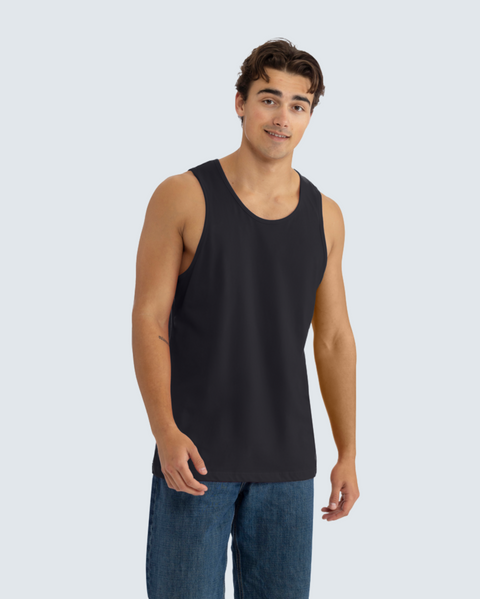
Here's the short version. A muscle tank has a deep armhole, sometimes cut almost to the waist, with narrow straps at 1-2 inches and a tapered body that narrows from chest to hem. A regular tank is a t-shirt without sleeves: standard armhole sitting just below the shoulder, 2-3 inch straps, straight silhouette. If you're buying your first tank top, get the regular. It does more in more places. For the longer explanation and which builds suit which cut, keep reading.
What Makes a Muscle Tank a Muscle Tank?
The armhole. That's the whole defining feature and everything else follows from it.
Cut the armhole deep and wide, on some versions it runs nearly to the waistline, add narrow straps maybe an inch and a half across, and taper the body so it's fitted at the chest and narrower at the hem. The original idea was getting fabric out of the way during overhead pressing and wide-grip pulling. Research in the Journal of Strength and Conditioning Research backs this up: fabric sitting on the shoulder joint does measurably limit range of motion on overhead lifts. So the "I'm showing you my entire ribcage" look has legitimate functional roots, even if the aesthetic itself is divisive.
But here's the catch nobody mentions on the product page. You're showing your whole side, armpit to hip, with nothing in between. And if you've got wide lats and a V-shaped torso, the muscle tank drapes exactly the way the designer intended and you look like a recruitment poster for whatever gym you attend. If you don't have that build, and I spent about four years in a body that could generously be described as "still loading," the open sides gap wide and the straps slide around and you spend half your workout adjusting the shirt instead of doing reps.
What Does a Regular Tank Give You Instead?
Coverage and versatility. That's the trade.
It sits just below your shoulder, close enough that nobody can see straight through to the other side of your body. Straps run about 2-3 inches wide. And the silhouette drops straight from shoulder to hem without any taper, which means it doesn't cling to your torso or reveal the exact outline of whatever you've been doing at the gym lately. Or not doing.
A regular tank also works in about four times as many situations as a muscle tank. Sure, it's fine for lifting. But it's also fine for the beach, for running errands on a Saturday when it's 92 degrees out, for layering under a flannel when the temperature is in that annoying in-between zone where you can't decide if you need sleeves or not. I've worn mine to restaurants, to friends' apartments, to the hardware store picking up drywall anchors. And nobody has ever commented on it, which is exactly the point. A muscle tank gets comments. A regular tank is just a shirt.
(We get emails about this mix-up more than you'd think. Guy buys a muscle tank assuming it's just a regular tank with a slightly different name, wears it to his buddy's cookout, and spends the entire afternoon feeling slightly off until someone finally asks if he just came from the gym.)
Which One Works Better at the Gym?
Depends what you're actually doing once you walk through the door.
Overhead presses, pull-ups, wide-grip rows, lateral raises: the muscle tank wins here and it's not close. And the open armhole means zero fabric interference, nothing bunching up under your arms, nothing pulling when you go wide. You basically forget you're wearing anything, which is the whole reason the garment was designed in the first place.
But bench press, curls, machines, moderate dumbbell work? Either one handles that fine. Your arms aren't going wide enough or high enough for the armhole to make a measurable difference (honestly the gap in range of motion at this level of movement is basically zero), so just grab whichever you pulled out of the drawer that morning.
One thing worth mentioning that I learned from personal experience: muscle tanks move around during explosive exercises. Box jumps, kettlebell swings, burpees. The narrow straps shift, the open sides catch air, and the shirt starts performing its own independent routine beside you. I watched a guy doing box jumps at my old gym in Bushwick where his muscle tank had basically become a cape. Regular tanks stay put because the wider straps and tighter armhole give them more contact surface with your body.
Does Your Build Change Which One You Should Buy?
Yeah. More than most guys want to hear.
Look, muscle tanks were pattern-drafted for a V-taper. Broad shoulders, visible lats, waist narrower than the chest. On that frame the tapered cut follows the body's natural line and everything sits where it's supposed to. The armhole opens at the right spot, the straps stay on the shoulders, and the whole garment reads as intentional rather than like something that happened to you by accident.
On a leaner build, the armhole gaps open too wide and the straps slowly migrate toward your neck throughout the day until the tank is basically a weird halter top. On a heavier build, the taper pulls across the midsection while the narrow straps dig into your shoulders uncomfortably. We see both situations in our exchange data constantly, and the story is always the same: customer goes up a size hoping that fixes it, and it doesn't. A bigger muscle tank just means a bigger gap. And that's a shape mismatch, not a sizing problem.
But regular tanks are far more forgiving. Wider straps stay put no matter your shoulder width, the straight-drop silhouette doesn't taper so nothing pulls or gaps, and the fit works on V-taper builds, heavier frames, and guys who haven't been to a gym since their New Year's resolution quietly expired in February.
| Attribute | Muscle Tank | Regular Tank |
|---|---|---|
| Armhole depth | Deep, sometimes to the waist | Standard, just below shoulder |
| Strap width | Narrow (1-2 inches) | Wide (2-3 inches) |
| Silhouette | Tapered from chest to hem | Straight drop, relaxed |
| Best gym use | Overhead lifts, wide-grip work | General lifting and cardio |
| Best casual use | Beach, pool, outdoor events | Pretty much anywhere |
| Build forgiveness | Low (designed for V-taper frames) | High (works across most body types) |
| Layering | Doesn't work (deep sides look odd) | Good under flannel or open shirts |
| Buy first? | Only if you already know you need it | Yes, start here |
So Which One Should You Actually Get?
If you train regularly with overhead movements and your build works with the cut, get a muscle tank for the gym and a regular tank for everything else. That's the most common setup we see from customers who end up owning both.
So if you're picking just one, get the regular. It handles the gym fine, handles everything outside the gym better, and fits more body types without any of the fussing. Browse both cuts in the men's tank top collection, each listing includes armhole width and strap measurements by size so you know what you're getting before it arrives at your door.
And if you're not sure where the armhole should sit on your particular frame, the tank top fit guide covers the specific measurements to check against your body.
Last updated: May 2026
FAQ
Can you wear a muscle tank casually outside the gym?
At the beach or a pool party where everybody's already half-undressed, nobody blinks at a deep armhole. And at an outdoor barbecue where the dress code is basically "showed up," you're fine. But a restaurant, a coffee shop, the grocery store? That depends heavily on what else you've got on. Chino shorts with clean shoes can pull it off. Full gym kit from head to toe and you look like you forgot to change after your last set. Context carries more weight than the tank itself.
Are muscle tanks only for bodybuilders?
No, but they were cut with that body shape in mind. The V-taper silhouette, wide shoulders tapering to a narrower waist, is literally what the pattern maker was looking at when they drafted the thing. Leaner guys and heavier guys can both wear them, but both will run into fit issues that have nothing to do with picking the wrong size. The armhole either gaps or the straps pull depending on your frame, and going up a size just scales the same problem bigger.
What fabric works best for a gym tank top?
Cotton blends handle moderate lifting fine, the kind where you rest between sets and you're not drenched by the end. For higher-intensity work like HIIT or sustained cardio, poly-elastane blends wick sweat away instead of absorbing it. Straight cotton soaks everything up, gets heavy, and starts sticking to your skin after about 30 minutes of serious effort. Most guys can get away with cotton for general lifting. If the session keeps your heart rate up the whole time, go synthetic.
Do muscle tanks run true to size?
They fit tighter than a regular tank because the tapered cut means the chest and shoulder area are fitted while the hem narrows toward the waist. If you're between sizes, go up. The armhole will sit better and the chest panel won't stretch out and cling to every contour of your torso. A muscle tank that's too tight just looks like you bought it before your last growth spurt and haven't accepted that fact yet.
Should a first tank top be a muscle tank or regular tank?
Regular tank. It works at the gym, works casually, works layered under a jacket, and fits more body types without requiring the specific shoulder-to-waist ratio that muscle tanks were cut for. The muscle tank is a specialist item for people who already know they need one. Most guys who own both eventually notice they reach for the muscle tank only on shoulder day and the regular tank gets worn the rest of the week.



0 comments