
Some clothing items get too much credit. Others get too little. The basic t-shirt is firmly in the second category. It sits quietly at the bottom of your drawer, gets pulled on without much thought, and does more work than almost anything else you own. If you have a good one, you barely notice it. If you have a bad one, you notice it constantly.
This guide covers what a basic tee actually is, why it matters, how to choose the right one, and how many you should have. No filler, no fluff. Just what you need to know to buy something you will actually wear.
What Makes a T-Shirt Basic
The word basic gets used as an insult sometimes, but in menswear it is a compliment. A basic t-shirt is defined by what it does not have. No graphics. No bold branding. No embellishments. Just a clean, simple crew neck or V-neck with short sleeves and a solid color.
That simplicity is the whole point. A basic tee is designed to work with everything. It layers under an open shirt, goes under a jacket, and stands on its own with jeans or chinos. Because it has no visual noise, it never fights with anything else you are wearing. It just works.
A regular t-shirt might have a logo across the chest, a graphic print, or a washed-out vintage design. Those shirts have their place, but they are not basics. They make a statement. A basic tee does the opposite. It gets out of the way and lets the rest of your outfit do the talking.
Why Basic T-Shirts Are the Foundation of a Men's Wardrobe
If you stripped your wardrobe down to the items you reach for most often, a few basic tees would almost certainly be near the top of the list. They are the most versatile piece most men own, and the most underrated.
Think about how a basic tee actually gets used. It is the layer under your flannel shirt on a cool morning. It is what you wear when you want to look decent but not like you are trying too hard. It is the thing you grab on a Saturday when you have no plans but want to look put together. It is the base layer under a blazer when you want something smarter than a button-down without the formality.
Nothing else in a man's wardrobe does all of that. A dress shirt cannot go under a flannel without looking odd. A polo is too preppy for some situations. A hoodie is too casual for others. The basic tee fills in all the gaps.
Building a small collection of quality basic t-shirts is genuinely one of the best investments you can make in your wardrobe. Not because they are exciting, but because they solve so many daily dressing problems without requiring any thought.
The Right Fabric for a Basic T-Shirt
Fabric is where most budget basics fall short. The cut can be decent but if the fabric is thin and scratchy it will never feel like a quality piece.
100% cotton. The standard for basics. Breathes well, softens with washing, and feels comfortable against skin. Look for 160 to 200 grams per square meter — anything lighter will go thin quickly and lose its shape after a few washes.
Pima or Supima cotton. Premium versions with longer fibers. Softer, stronger, and more resistant to pilling. If you are buying basics you plan to wear for years, the upgrade is worth it.
For most men, medium-weight ring-spun cotton is the right starting point. See the t-shirt fabric guide if you want to go deeper on materials.
How a Basic T-Shirt Should Fit
Fit is the difference between a basic tee that looks sharp and one that looks sloppy. The fabric can be excellent and the color can be perfect, but a poor fit undoes all of it.
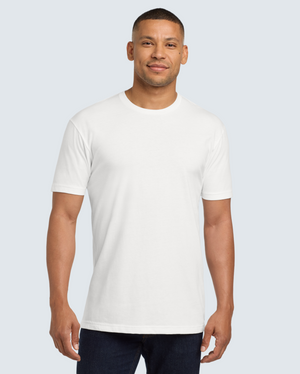
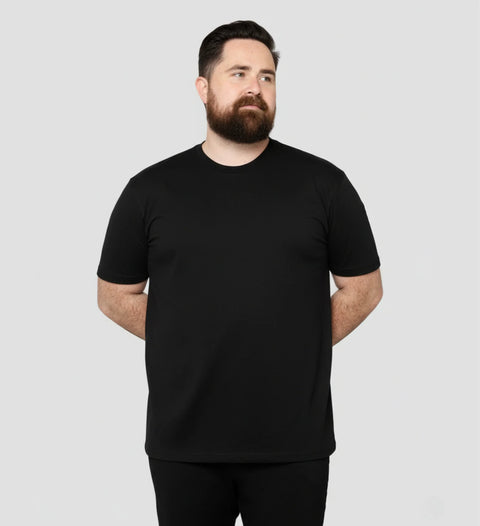
The shoulder seam should sit at the edge of your shoulder, not hanging down your arm and not pulling toward your neck. The chest should be close to your body without pulling or stretching across it. The hem should fall somewhere around your hip bone, long enough to stay tucked if you want it tucked but not so long it looks wrong untucked.
The sleeves are where a lot of basic tees get it wrong. They should end at mid-bicep, not past your elbow and not riding up to your shoulder. If the sleeves are baggy or overly long, the whole shirt reads as too big even if the body fits fine.
For a complete breakdown of proportions and what to look for by body type, the guide on how a t-shirt should fit covers it in detail.
How Many Basic T-Shirts to Own
The honest answer depends on how often you do laundry and how often you wear them. But here is a practical baseline for most men.
If you do laundry once a week, you probably want somewhere between five and eight basic tees. That gives you enough to rotate through the week with some flexibility. If you work from home or have a casual dress code at work, you might lean toward the higher end because you will reach for them more often. If you wear a uniform or button-downs most of the week, fewer will do.
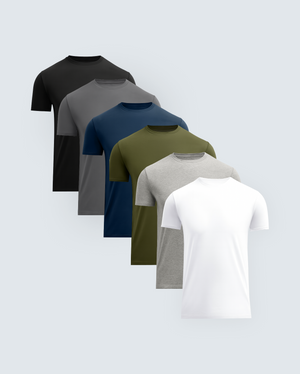
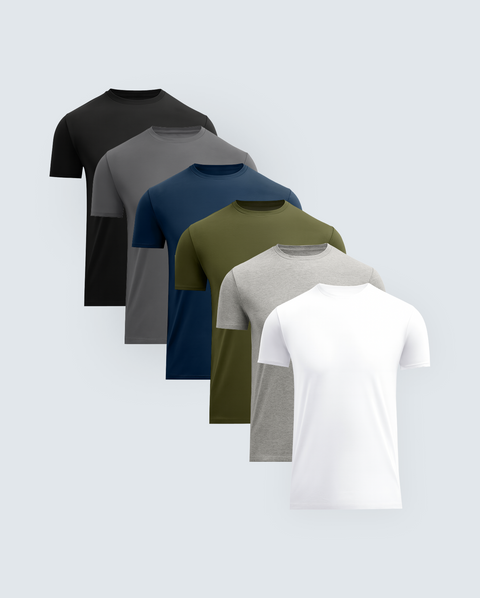
A good starting point for most men is seven. Three to four in white and grey (the most versatile colors), two in black, and one or two in a color like navy or olive. That covers the majority of what you will ever need a basic tee for.
The goal is not to have so many that you stop caring about quality. Fewer good ones will serve you better than a drawer full of mediocre ones. Replace them when they start to thin out, develop holes, or lose their shape.
The Colors Worth Owning
You do not need every color. You need the right ones.
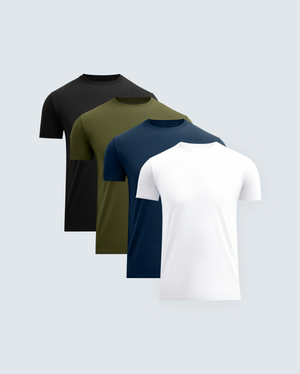
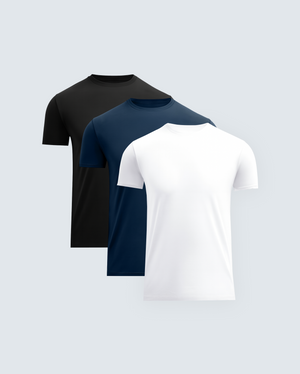
White. The most versatile basic. Works under anything, works on its own. Buy two minimum.
Grey. Heather grey specifically. Easier to maintain than white and works with nearly as many outfits.
Black. Sharp under a jacket, good in the evening, hides stains well. Quality matters more here because fading is obvious on black.
Navy. A more interesting alternative to black that still pairs with almost everything.
Once you have those four covered, one muted tone — olive, stone, slate blue — adds variety without complicating things. Stay away from bright colors; at that point they stop being basics. Browse the full range in the men's t-shirts collection.
FAQ
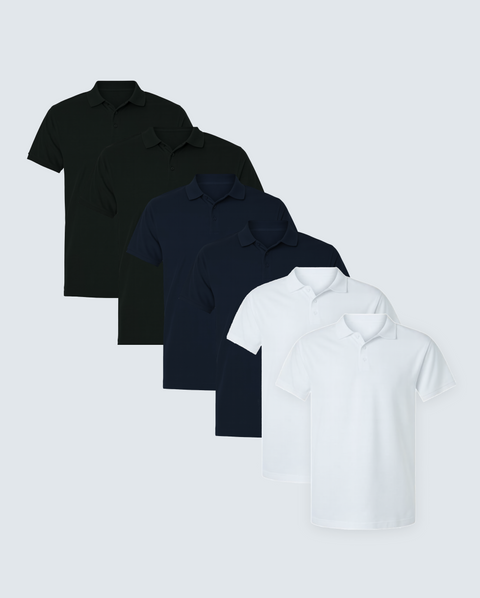
When a plain tee is not quite enough for the occasion, a men's polo shirt is the most natural next step. The collar does the work a crewneck cannot, and you still get the same ease of a knit fabric without needing a button-down or a jacket.
What is a basic tee?
A solid-color t-shirt with no graphics, logos, or decorative details — typically a crew neck or V-neck with short sleeves. Because it has no visual noise it works as a standalone piece or as a layer under almost anything. Basic tees are the foundation of a functional, low-effort wardrobe.
What is the best basic tee for men?
Look for medium to heavy weight cotton, a neckband that holds its shape, and preshrunk fabric so the fit stays consistent after washing. The basic t-shirts collection is built around those qualities — fabrics that hold up to regular wear without thinning out.
How many t-shirts should a man own?
Five to eight is a practical range for weekly laundry. Start with white, grey, and black. Add navy or a muted earth tone once you know what you reach for most. Five good tees that last three or four years will serve you better than a drawer full of cheap ones you replace every season.



0 comments