
I used to own maybe twelve short sleeve t-shirts and exactly one long sleeve that I got from running a charity 5k in 2019. The ratio felt right to me for years because I live in a place where it gets properly hot for about five months. I just assumed short sleeves were the year-round default and long sleeves were something you wore under a flannel on the rare weekend it dropped below 60.
Then I moved somewhere with actual shoulder seasons, those stretches in April, May, September, and October where the temperature sits in this annoying 55-to-70 degree range that's too warm for a hoodie and too cool for bare arms. And I suddenly had nothing to wear for about four months of the year. My short sleeves felt unfinished and my one long sleeve was starting to develop that particular smell that cotton gets when you've worn it three times a week for six weeks straight.
Key Takeaways
- Long sleeve t-shirts own the 55 to 70 degree range where short sleeves feel unfinished and sweatshirts feel like too much, and the most common exchange pattern we see on long sleeves is guys who bought one for layering and ended up wearing it solo because the silhouette worked better on its own than they expected.
- Short sleeves win above 75 degrees and any time you're layering under something heavier that completely hides the sleeve, because at that point the long sleeve is just adding bulk nobody can see.
- Our long sleeve tees use combed ring-spun cotton in an 80/20 cotton-poly blend, and the real case for owning more than one long sleeve is layering: a visible cuff under a jacket or open flannel is a styling detail that short sleeves can't replicate no matter how you position them.
The quick answer: long sleeves own shoulder season (55 to 70 degrees) and any outfit where you want to look slightly more put-together without adding layers. Short sleeves win in summer heat (75+) and under heavier layers where the sleeve disappears anyway. If you're deciding between the two for a specific situation, check the temperature and whether any sleeve will actually be visible once you're dressed. If that's enough, close the tab. For why each one works where it does, what fabric weight to aim for, and my honest take on how many of each you actually need, keep reading.
Does Sleeve Length Actually Change How an Outfit Looks?
More than I expected when I first started paying attention to it.
Put on a short sleeve and look in the mirror. Your arms are the main event, which is fine for a Saturday errand run. But it starts to feel a bit exposed when you're meeting someone for dinner or walking into a slightly nicer restaurant than you planned on. Swap to a long sleeve in the same colour and your arms disappear into a continuous line from shoulder to wrist. And the whole thing looks a touch more intentional without you having done anything except change which shirt you grabbed.
There's a tactile thing too that I didn't expect to care about but now notice every time. You can feel the fabric on your forearms all day, this gentle compression that's almost like wearing a light layer you forgot about after ten minutes. Weird description, I know. But once you notice it, going back to bare forearms in anything below 65 degrees feels like you're underdressed even if you're technically comfortable.
When Does a Long Sleeve Beat a Short Sleeve?
Shoulder season is the obvious one, and honestly it's the strongest argument for owning more than one.
When the weather sits between 55 and 70 degrees (which in most of the US covers big chunks of April, May, September, and October), you're stuck in this annoying wardrobe gap where a short sleeve alone feels cold and a hoodie is overkill for walking around at lunchtime. A long sleeve t-shirt splits that difference without making you think about layering at all, and I wore one almost every day last October without ever reaching for a jacket.
But the layering argument is even stronger. A long sleeve under an open flannel or an unzipped jacket gives you a visible base layer at the wrist. That cuff peeking out looks like you planned the outfit rather than just grabbing whatever was clean. Short sleeves can't do this. I tried rolling my jacket sleeves once to make a short sleeve work as a visible layer and it looked like my jacket was broken.
Sure, there's also the formality angle. A long sleeve tee with clean trousers and decent shoes reads like an actual outfit that someone assembled on purpose. The same trousers and shoes with a short sleeve? Looks more like you're killing time before your real plans start, and I've made this mistake at least twice at restaurants where I walked in and immediately wished I'd grabbed the long sleeve instead.
Should You Reach for a Short Sleeve Instead?
Summer heat. Anything above 75 and climbing.
A long sleeve in real summer is just more surface area trapping warmth against your body. The fabric on your forearms holds sweat in a way that cotton doesn't handle gracefully. The cuffs get damp, your wrists feel clammy, and by noon you're rolling the sleeves up anyway, which just makes you look sloppy rather than casual. Skip it.
The gym is obvious too. Long sleeve tees ride up the moment you bend your elbow under load, bunching at the bicep and generally getting in the way of whatever you're trying to do with your arms. For guys with broader builds, that bunching at the bicep is even worse because there's more arm fighting against the fabric. I've ripped a sleeve seam on a dumbbell curl before, which was embarrassing in the specific way that only minor gym wardrobe failures can be.
And under heavier layers where the sleeve won't show? If you're putting on a crewneck sweatshirt that covers your arms completely, a long sleeve underneath just adds bulk at the bicep and warmth you probably don't need. A short sleeve base layer lies flat under the outer layer and stays invisible.
Long Sleeve vs Short Sleeve: Side-by-Side
| Attribute | Long sleeve | Short sleeve |
|---|---|---|
| Best temperature range | 55 to 70°F (shoulder season) | 75°F and above (summer) |
| Layering versatility | Visible cuff adds a styling detail | Disappears cleanly under heavier layers |
| Visual formality | More intentional, closer to smart-casual | Casual to athletic |
| Gym and active use | Rides up, bunches at the bicep | Full range of motion, stays cool |
| Summer comfort | Too much fabric, cuffs collect sweat | Minimal coverage, breathes well |
| Ideal fabric weight | 170 to 200 GSM | 130 to 180 GSM |
| Tucked into trousers | Sleeve completes the look | Can look underdressed |
| Base layer under jacket | Best when cuff shows at wrist | Best when fully hidden |
What About Fabric Weight for Each?
This matters more than most guys realise. I didn't think about it at all until I bought a long sleeve that was so thin the sleeve looked papery against my arm and basically transparent in direct sunlight.
For short sleeves in summer, lighter is better. Something in the 130 to 150 GSM range keeps the fabric from clinging when you sweat, and bamboo viscose blends are worth trying if you run warm. The fibre has a micro-gap cross-section that moves moisture away from skin faster than cotton (a study published in ACS Sustainable Chemistry confirmed the structural differences in bamboo viscose fibres that enable this). Our 70/30 bamboo viscose to organic cotton blend at 5.3 oz/yd² breathes noticeably better than a standard cotton tee at the same weight.
Long sleeves need a bit more body to the fabric. I've found that 170 to 200 GSM is the sweet spot where the sleeve holds its shape on your forearm without looking stiff or heavy. Too light and it clings to every contour of your arm, which looks cheap. Too heavy and it stops working as a comfortable base layer under anything else.
How Many of Each Do You Actually Need?
Well, here's my honest take after fixing my own ratio over the past couple of years.
Most guys own too many short sleeves and not enough long sleeves. I used to have maybe twelve short sleeves and one long sleeve, and now I keep about seven of each. Two or three neutral long sleeves in black, navy, and grey completely changed how I dressed for those 55 to 70 degree days. Instead of reaching for a hoodie I didn't really need or wearing a short sleeve and being slightly cold all afternoon, I just grabbed a long sleeve and walked out the door without thinking about it.
If you live somewhere without real shoulder seasons (proper hot nine months of the year), you probably don't need more than two long sleeves and that's fine. But if you get actual spring and autumn? Invest in at least three. You'll wear them more than you think.
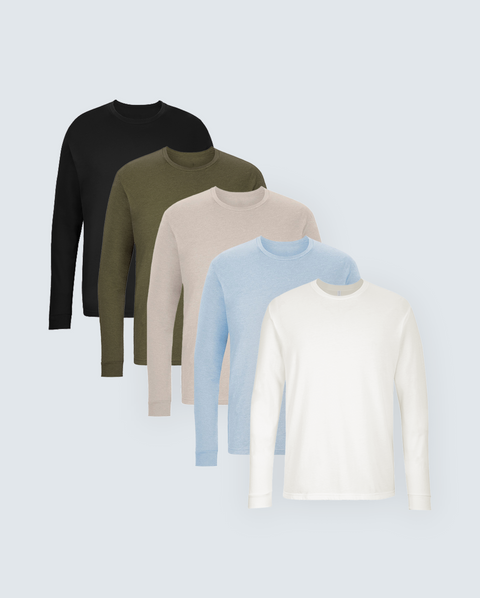
The full men's long sleeve range runs the same body fit as the short sleeve line, so they layer cleanly without adding bulk through the torso. And the fabric guide covers how different blends handle moisture and temperature if you want to get more specific about what works best for your climate and your typical day.
Last updated: May 2026
FAQ
Can you wear a long sleeve t-shirt in summer?
In air-conditioned offices or cool indoor spaces, a long sleeve t-shirt works fine in summer, and I wear mine to the office in July without thinking about it. But outdoors above 75 degrees, you'll overheat because the extra fabric holds body heat against your skin in a way that gets uncomfortable within about twenty minutes. Save long sleeves for shoulder season or evening wear when the temperature drops after sunset.
Are long sleeve t-shirts good for layering under jackets?
Long sleeve t-shirts are one of the best base layers for jackets, especially when the sleeve cuff peeks out past the jacket cuff at the wrist. That visible cuff looks like a deliberate styling detail rather than an accident. But if the jacket fully covers the long sleeve underneath, switch to a short sleeve base layer instead, because the long sleeve just adds bulk at the bicep and bunches inside the outer sleeve without giving you any visual payoff.
What fabric weight works best for a long sleeve t-shirt?
Ring-spun cotton between 170 and 200 GSM handles most situations well. That weight range feels soft enough against your skin for all-day wear but gives the sleeve enough body so it doesn't cling to your forearm or look papery. Bamboo viscose blends (like a 70/30 bamboo-cotton at 5.3 oz per square yard) are worth trying if you run warm, since the fibre's micro-gap cross-section moves moisture faster than cotton alone.
Should a long sleeve t-shirt fit the same as a short sleeve?
The body fit should match: shoulders, chest, torso length, all the same measurements you'd check on a short sleeve. But the difference is sleeve length, which should land at the wrist bone when your arms hang naturally at your sides. Not mid-forearm, not bunching past your hand. Some guys size up in long sleeves chasing sleeve length, but that loosens the body fit everywhere else, which defeats the purpose.
Do long sleeve t-shirts work for smart-casual outfits?
Better than short sleeves in almost every smart-casual scenario, and I've worn a solid black long sleeve with dark trousers and leather shoes to client dinners without anyone questioning it. The same trousers and shoes with a short sleeve looks more like you're on your way to get groceries. That extra sleeve coverage adds a bit of visual formality that quietly upgrades the whole outfit without actually dressing up.


0 comments