
I found my first polo collar sweatshirt in the back of a thrift store about three years ago and didn't know what I was looking at. It had the ribbed cuffs and the weight of a regular sweatshirt, but then there was this collar sitting on top, flat and structured with two buttons at the front, and I remember holding it up and thinking it looked like someone had cut the collar off a polo shirt and stitched it onto a crewneck. Which, honestly, is more or less exactly what happened at some point in menswear history.
I bought it for four dollars because the colour was right and the shoulders looked like they'd fit. And then I wore it to dinner that night with dark jeans and boots, and my friend asked me where I got it because he'd been looking for something that wasn't as casual as a hoodie but wasn't a button-down shirt either. That's when I realised this thing fills a gap that most guys don't know they have in their wardrobe until someone points it out.
Key Takeaways
- A polo collar sweatshirt is a mid-weight fleece or French terry body (280 to 340 gsm) with a flat polo collar and a 2 or 3 button placket, and the collar alone shifts the piece from purely casual into smart-casual territory without needing a jacket or blazer over it.
- Our polo collar sweatshirts use an 80% cotton / 20% polyester blend in brushed fleece, and the most common reason guys swap a crew neck for a polo collar version is that the collar provides enough structure for offices and restaurants where a crew neck feels like loungewear.
- Navy and grey handle the widest range of trouser colours and settings, and it layers cleanly under an unstructured blazer with the collar tips visible above the lapel for a look that reads deliberate without trying hard.
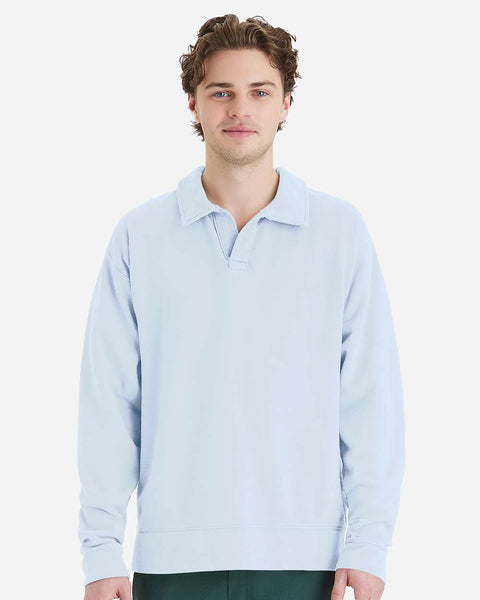
The quick answer: a polo collar sweatshirt is a regular sweatshirt body (mid-weight fleece, ribbed cuffs and hem) with a structured polo collar and button placket. That collar does more work than you'd expect, because it's the one detail that takes the piece from weekend-on-the-couch territory into something you can wear to a casual office, a dinner, or under a blazer without looking underdressed. If you've been wanting something warmer than a polo shirt but less sloppy than a hoodie, this is the piece. If that answers it, close the tab. For how it compares to other sweatshirt styles, how the fit should work on different builds, and what to actually wear it with, keep reading.
What Is a Polo Collar Sweatshirt, Exactly?
Start with the body. It's standard sweatshirt construction: mid-weight fleece or French terry, typically 280 to 340 gsm. Ribbed cuffs, ribbed hem. The same warm, familiar fabric you already know from every crewneck sweatshirt you've ever owned.
And then there's the collar. A flat, structured polo collar with a short button placket, usually two or three buttons, and the collar points lay down against the chest the same way they would on a polo shirt. No standing collar, no turtleneck, no zip. Just the collar and the buttons.
But here's what surprised me about my thrift store find. That collar changed how the whole garment came across in a way I genuinely didn't expect. I'd been wearing crew neck sweatshirts for years and they always read as inherently casual, which is fine for Saturdays but creates that awkward moment when you walk into a restaurant and feel like you're the only person who didn't get the dress code memo. Add a structured collar to the same sweatshirt body and suddenly it looks like something you chose on purpose rather than something you grabbed because it was on top of the laundry pile. Research on clothing perception confirms what I noticed in my own mirror: collar structure is one of the strongest signals of intentional dressing in casual menswear.
How Does It Compare to Other Sweatshirt Styles?
This is the question I get from friends more than any other, usually phrased as "so it's like a quarter zip but with a different collar?" And no, not really, because the construction and the formality level are different enough that they serve different purposes in your closet.
| Style | Collar type | Weight range | Formality | Best for |
|---|---|---|---|---|
| Polo collar sweatshirt | Flat polo with button placket | 280-340 gsm | Smart-casual | Office, dinner, blazer layering |
| Crew neck sweatshirt | Round ribbed neckband | 260-320 gsm | Casual | Weekend, errands, couch |
| Hoodie | Hood with drawstring | 280-360 gsm | Very casual | Gym, lounging, cold weather |
| Quarter zip | Stand collar with half zip | 260-300 gsm | Casual to smart-casual | Layering, outdoor, golf |
| Turtleneck sweatshirt | Tall folded collar | 280-340 gsm | Smart-casual to dressy | Date night, blazer layering |
The biggest difference between a polo collar sweatshirt and a quarter zip is the formality ceiling. A quarter zip tops out somewhere around business-casual golf, which is a specific kind of casual that my friend Mike wears every single day and I've come to accept as its own dress code. But a polo collar sweatshirt goes higher because the collar looks like it belongs on a shirt, and that tricks the eye into registering the whole outfit as more put-together than it actually is.
How Is It Different from a Polo Shirt?
Same collar shape, completely different garment. A polo shirt is lightweight cotton pique at 180 to 220 gsm. You feel air through it. It creases if you look at it wrong.
A polo collar sweatshirt is fleece or French terry at 280 to 340 gsm. You feel the weight when you pull it on. Different warmth, different structure, different purpose.
Well, while we're sorting out the naming: a polo collar sweatshirt isn't a polo neck. A polo neck is a turtleneck (high, folded, covers your neck up to your chin). I had an argument with a coworker about this in 2023 that lasted an embarrassingly long time before we realised we were picturing two completely different garments.
When Should You Actually Wear One?
This is the part I care about most because I've spent three years testing the limits of where a polo collar sweatshirt works and where it doesn't, and the range is wider than I expected when I bought that four-dollar thrift store find.
Chinos and clean sneakers. The collar makes a standard casual outfit look like you've got an actual plan for the day. I wore this combination for most of last autumn and nobody ever asked if I was heading to the gym, which is more than I can say for the hoodie I used to wear with the exact same trousers.
Dark jeans and leather shoes. This pushes into smart-casual without any effort at all. Keep the jeans dark and relatively slim (no distressing, obviously). I've worn this to at least five restaurants where a hoodie would have felt genuinely wrong and a button-down would have felt like I was overdoing it.
Under a blazer. This is where it gets interesting and where I think the polo collar sweatshirt earns its keep more than any other context. The collar tips peek above the blazer lapel and give the look some architecture that a crew neck simply can't provide. Navy sweatshirt under grey blazer. Charcoal under camel. Both work without overthinking, and I've done each at least a dozen times.
Skip it for formal events, job interviews at traditional firms, and the gym. The collar has no business near a squat rack, and I say that as someone who once accidentally wore one to the gym because I grabbed the wrong thing out of my bag.
And colours for each context matter more than I initially thought. Navy works everywhere, which is boring advice but true advice. Charcoal under a blazer reads slightly dressier than navy, which can be useful if you're testing the upper edge of what a sweatshirt can handle in a more polished setting. I keep olive for weekends because it pairs with dark denim in a way that feels autumnal without looking like I'm trying to dress for a catalogue shoot. And grey is the fallback that works when nothing else seems right, which happens more often than I'd like to admit.
Does the Fit Matter More Than You'd Think?
Yes. Way more.
The collar is structured but the body isn't, and that creates a specific tension that the fit has to resolve. If the body is oversized (shoulders drifting past the joint, fabric billowing at the waist), the structured collar looks like it wandered in from a different outfit and doesn't know where it belongs. And if the body is skin-tight, the collar gets pushed and distorted by fabric tension, which looks uncomfortable even if it doesn't feel that way.
Sweet spot: relaxed but not shapeless. Shoulder seam sitting at the joint where your arm meets your torso, not sliding halfway down your bicep. Body that skims your torso without clinging to it. I check these two things before I even look at the collar now because if the body fit is wrong, no collar in the world saves the outfit.
Sure, for guys with broader builds, this is actually a really decent piece and probably better than a crew neck in most situations. The collar draws the eye to the neckline and creates a vertical line from the button placket that visually narrows the upper body (same optical principle as a v-neck, just achieved differently). But don't size up to get more room through the chest and let the shoulders drift past the joint. That defeats the whole point. Check the chest measurement on the size chart independently of the shoulder measurement, because going up a full size trades one problem for another.
What Colours Should You Start With?
Navy. Always navy first.
I've tried to talk myself into starting with grey or black because my closet has too much navy already, and every time I reach for the navy polo collar sweatshirt first anyway because it pairs with basically every trouser colour I own, works in casual and smart-casual settings equally, and doesn't show wear quickly (which matters more than people think when you're wearing the same piece twice a week for three months straight).
Grey is the second pick. It's the safer neutral that works under a darker blazer where navy might clash. And then earth tones, olive or tan, are solid seasonal additions that lean more autumn and winter, which is fine because that's when you're wearing a sweatshirt anyway.
Look, skip anything bright for your first polo collar sweatshirt. A red or royal blue polo collar sweatshirt needs to be the focal point of the entire outfit, and until you've figured out how to style the piece in neutral tones, making it the loudest thing you're wearing just adds a variable you don't need.
Browse the full range in the polo collar sweatshirt collection. And the styling guide for polo collar sweatshirts covers specific outfit combinations if you want to go beyond the basics I've covered here.
Last updated: May 2026
FAQ
What exactly is a polo collar sweatshirt?
A polo collar sweatshirt is a mid-weight sweatshirt (fleece or French terry, 280 to 340 gsm) with a flat polo-style collar and a 2 or 3 button placket. The body is standard sweatshirt construction with ribbed cuffs and hem. That collar pushes the piece past pure casual without going near shirt-and-tie formality.
Can you wear a polo collar sweatshirt to a business casual office?
In most business-casual offices, yes. Pair it with chinos and leather shoes and the collar looks intentional. Won't pass in a suit-and-tie environment. But for offices where a fitted polo works, a polo collar sweatshirt sits at the same formality level with more warmth.
What is the difference between a polo collar sweatshirt and a turtleneck?
A turtleneck (sometimes called a polo neck, which causes the confusion) is a tall folded collar covering most of the neck. A polo collar is the flat, pointed collar with a button placket, same as on a polo shirt. Completely different silhouettes. The naming overlap trips people up constantly.
Can you layer a polo collar sweatshirt under a blazer?
Yes. The collar tips show above the lapel and give the look structure that a crew neck can't provide. Keep the sweatshirt solid and the blazer unstructured. Navy under grey or charcoal under camel both work without overthinking.
What colour polo collar sweatshirt is most versatile?
Navy. Pairs with nearly every trouser colour, works in casual and smart-casual settings, and doesn't show wear quickly. Grey is the next safest pick. Earth tones like olive or tan are solid seasonal adds but lean more towards autumn and winter.



0 comments